Elections to the Tamil Nadu Assembly were held on 21 January 1989 bringing the curtain down on President’s Rule. The DMK contested the elections in alliance with the CPM and the Janata Dal (of V.P. Singh). The AIADMK (Jayalalitha) allied with the CPI while the AIADMK (Janaki) allied with Sivaji Ganesan’s outfit, the Thamizhaga Munnetra Munnani. The Congress under Mooppanar contested the elections on its own. In this multi-cornered contest, the DMK alliance saw a thumping victory with 169 seats, the AIADMK (Jayalalitha) alliance got 27 seats, the Congress won 26 seats, while the Janaki faction won just 2 seats. The elections were significant for two reasons:
(1) Janaki Ramachandran retired from politics and the two AIADMK factions merged under Jayalalithaa and
2) Congress never contested the subsequent elections without an alliance with a major Dravidian party.
Karunanidhi was sworn in CM on 27th January 1989. I was happy that the President’s Rule was over because I finally got to spend time with Kausalya and the children. My workload came down drastically and I enjoyed my free time very much. The Governor accepted a number of public functions but that didn’t affect me in any way.
******
On 24th March, we heard the sad news that my mother-in-law had passed away in Bangalore. She was only 66. A gentle, noble and affectionate soul, she wanted to spend the last few months of her life in her house where she had spent more than 30 years. Kausalya, who was very close to her mother, was inconsolable. Thankfully I was able to spend quite a bit of time with her during that difficult period. Varalakshmi’s comforting words and the distraction provided by the 11month-old Radhika helped in lessening the grief somewhat.
A couple of weeks after Radhika’s first birthday, I had to go to Ooty with the Governor because he wanted to stay in the Ooty Raj Bhavan for a few days. 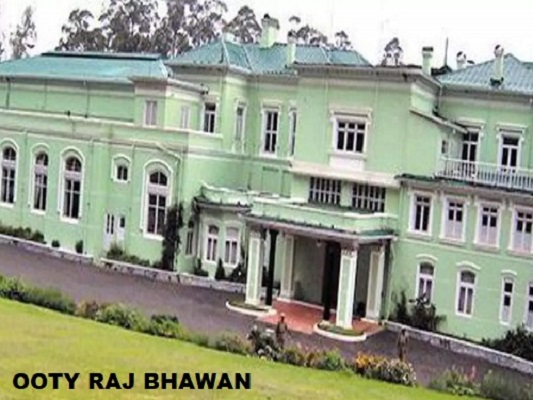 The Governor is entitled to travel by a saloon coach whenever he travels by rail. It is like a moving house with two bedrooms and attached bathrooms, a living-cum-dining room and a pantry. Rahul was 12 years old then and I took him along to Ooty. I wanted Kausalya to come because I thought the change would help her get over the depression caused by her mother’s untimely demise. But she was not in a mood for a holiday and moreover, she felt that the baby was too small to be taken on tours. The Raj Bhavan in Ooty is much more spacious and beautiful than the Madras Raj Bhavan. There are a number of suites, a banqueting hall, ballroom and reception rooms. Rahul was very excited because we could play badminton and table tennis. We also enjoyed the food cooked by the Raj Bhavan chef and his team. Our faithful peon Joseph also travelled with us to Ooty and Rahul had him for company most of the time when I was away on work. My only regret was that Kausalya was not there to enjoy it all. She would have loved the building, the beautiful old portraits and paintings and the outings Rahul and I had. We stayed in Ooty for about three weeks.
******
The relationship between the Governor and the CM was correct but not great. Karunanidhi always looked at the Governor as the Centre’s agent. There were a couple of occasions when their differences threatened to become serious but died down ultimately. On one occasion, when the Governor expressed his unhappiness to me on the CM’s proposal to create the Animal Sciences and Veterinary University without discussing the matter with the Governor who was the Chancellor of the Agriculture University (from which the new university was being created), I brought this to the notice of the Chief Secretary and suggested that he should meet the Governor and explain the rationale. The Governor was particularly peeved that the new Bill envisaged making the CM the Chancellor of the new university against all conventions followed till then. When the Chief Secretary called on the Governor, Alexander made his displeasure known in no uncertain terms. The CS conveyed the Governor’s misgivings to the CM and after hectic consultations it was decided to keep the Governor as Chancellor of the new university. The CM called on the Governor with his revised proposal and the Governor gave his assent. On another occasion a Bill passed by the Assembly was returned by the Governor for reconsideration since it was not in accordance with the spirit of the Constitution. Before returning it, the Governor consulted some constitutional experts. The Government thought the better of it and did not send it to the Governor again.
When the State was under President’s Rule, Alexander had appointed some of the best persons as Vice-Chancellors purely on merit. The Chief Ministers generally want to appoint VCs themselves or have a say in the matter. Even today it is a big issue in some States like Kerala and West Bengal. While Alexander kept the Government in the loop, he made it clear that his decision would be final. Thankfully there was no major controversy in the appointment of VCs till he demitted office.
Alexander was liberal in his outlook and very secular in his approach. He was a Syrian Christian by birth but rarely visited the church while in Chennai. However, whenever he went to Kerala, he made it a point to visit his hometown Mavelikara and the Orthodox Church there. He and Ackama had great regard for the Kanchi Paramacharya and called on him at the mutt. In fact his wife, to my knowledge, visited the mutt three or four times. Alexander was also keen to visit the Sri Venkatachalapathi temple at Tirumala and wanted me to find out whether there are any restrictions on people from other faiths visiting the shrine. I was informed by the temple authorities that he could visit the temple provided he gave a declaration that he had faith in Lord Venkateswara. When I apprised him of the position, he dropped the idea because his conscience would not allow him to give a false declaration.
******
General elections to the Lok Sabha were held in November 1989. The Bofors scandal had dented the image of the Congress, and the party could not get a majority. Though the Congress was the largest party with 197 seats against the Janata Dal’s 143 and the BJP’s 85, the National Front, a coalition of parties led by the Janata Dal, formed the government with outside support from the BJP, and V.P. Singh became Prime Minister. I’m mentioning this because this development was going to impact Tamil Nadu.
In February 1990, C. Subramaniam was appointed Governor of Maharashtra. He requested Alexander to send someone to brief him about the perks and privileges to which the Governor was entitled and about the functioning of the Governor’s household. Alexander sent me to meet C. Subramaniam at his Kotturpuram residence. The meeting, which lasted about 40 minutes, is etched in my memory because it was the only time I met with a person who was a household name even in my school days- he was the Minister of Education and Finance in Kamaraj’s cabinet. He was considered one of the most efficient Ministers both in the State and Centre and my admiration for him increased over the years. Never would I have imagined in my schooldays when I saw his photograph in my textbook that one day I would sit with him and brief him on his privileges! I saw firsthand how thorough he was in his preparation before assuming office as Governor. By a strange coincidence, Alexander succeeded him as Governor of Maharashtra in 1993.
******
As in the previous year, the Governor and his wife wanted to spend a month in Ooty in the summer of 1990. I tried to persuade Kausalya to come with me but she was reluctant. She felt that it would be difficult to look after such a small baby in a cold place like Ooty. I left for Ooty with Rahul in the first week of May. Joseph was with us this time also.
I had joined the MA (Eco) course offered by Madras University through distance education mode a couple of years earlier. But I could neither study nor appear for the exam in 1988 or 1989. I thought I should appear for the exam in May 1990. Ooty was one of the centres available and after taking the Governor’s permission, I sent my application for appearing from Ooty. It was quite a relaxed holiday in Ooty. Rahul and I enjoyed ourselves playing a lot of games. The Raj Bhavan had a number of books and Rahul spent time poring over them. I was also able to prepare for my examination undisturbed. The examination was to start on the 24th May.
On 20th May, which was a Sunday, I received a call from the Chief Secretary at about 9 pm. He told me that he received a message from Delhi that Surjit Singh Barnala, a former Union Minister, has been appointed as Governor of Tamil Nadu. He wanted me to break the news to the Governor and get his instructions. I was shocked. It was not a pleasant job to do. I was also worried that I would once again not be able to write the examination. The Governor had not retired to bed. I told him what the Chief Secretary told me. He didn’t seem shocked or surprised. (Ackama Alexander told me later that once V.P. Singh became PM, Alexander expected to be removed anytime.) He simply said “OK. We’ll leave for Madras tomorrow evening by train. Make all arrangements.” I hesitantly told him about my examination. He said, “You can take it next time.”
I called the Chief Secretary and informed him about the Governor’s decision to return immediately. I also got in touch with the Secretary (Public) and the Railway authorities to get the saloon coach ready.
We were back in Madras on Tuesday morning. A message was received from Barnala that he would like to be sworn in on 24th May. Alexander decided to leave on the day his successor arrived. I felt sad because he was, for me, a father figure and a role model.
******
Surjit Singh Barnala was a politician and was Chief Minister of Punjab when the Akali agitation was at its peak. Very soft spoken and mild mannered, he was well respected across the political spectrum. One of his sons, Gagan, who later became MLA in Punjab, spent most of his time in the Raj Bhavan, Madras, and interfered a lot in the administration of the household.. There were regular visitors from Punjab, especially the Governor’s native place, of people seeking recommendations for college admissions, jobs in the private sector, medical treatment, etc. The Governor wanted to help them as much as he could. That was Barnala’s major weakness. He could not say “no” to his people whether they were deserving or not. The Comptroller and the ADC and the vice-chancellors who had to face these problems most of the time felt uneasy. I told the Governor politely that giving admissions in engineering and medical colleges out of turn would not only get the officials concerned into trouble, but would also attract criticism of the Governor himself. He just said “I understand”.
I had to start writing speeches for the Governor again. But Barnala was not very demanding. He didn’t expect long speeches and was quite happy with what I wrote. Very often, he would deviate from the text and narrate some incident from his experience as Chief Minister or Union Minister which I thought was a good way of holding the audience’s attention.
But I started getting bored of the work at Raj Bhavan. I did not feel comfortable with the Governor’s style of functioning and the new environment. I told the Governor that I needed a change and wanted to work in the Secretariat. He was very nice. He told me that he was happy with me and would like me to continue but if I insisted, he would tell the Chief Minister. I briefed the Chief Secretary about this conversation. Within a few days I was transferred and posted as Secretary (Transport). I worked with Barnala for less than three months. I was happy to go back to the Secretariat.
I did not dislike Barnala. Neither am I implying that he was a weak man. He showed a few months later that he had the courage of conviction when he refused to recommend the dismissal of the DMK government and imposition of President’s Rule despite pressure from the Chandrasekar government. As a punishment he was transferred to Bihar. He did not go but chose to resign instead. He had not even completed nine months as Governor.
******
After demitting office, Alexander moved to Bangalore. He started writing a syndicated column for some newspapers and magazines. We used to keep in touch. Meanwhile, there were many developments in Delhi. V.P. Singh resigned because the BJP withdrew support. Chandrasekar succeeded him as PM. The DMK government was dismissed for allegedly supporting the LTTE and acting against the national interest and President’s Rule was imposed again. I thanked my stars that I was not there at that time. Rajiv Gandhi was assassinated by the LTTE in May 1991 in Sriperumpudur. Chandrasekar had to resign and P.V. Narasimha Rao became PM in 1991 since the Congress had emerged as the largest party in the 1989 elections. Alexander had been close to Narasimha Rao for a number of years and the return of Narasimha Rao from political sanyas saw the revival of fortunes for Alexander also. When C. Subramaniam resigned as Governor of Maharashtra in January 1993, Alexander was appointed to succeed him. He had a long tenure of more than nine years.
My brother Narasimhan narrated an incident that happened when he was Chief Post Master General, Bombay. He called on Alexander, who was the Governor then, in connection with an official event. When he mentioned to him that I was his brother, Alexander was very happy and talked glowingly about me. When Anna narrated this event he was so proud that his voice choked with emotion. I was touched by both Anna’s love for me and Alexander’s kindness.
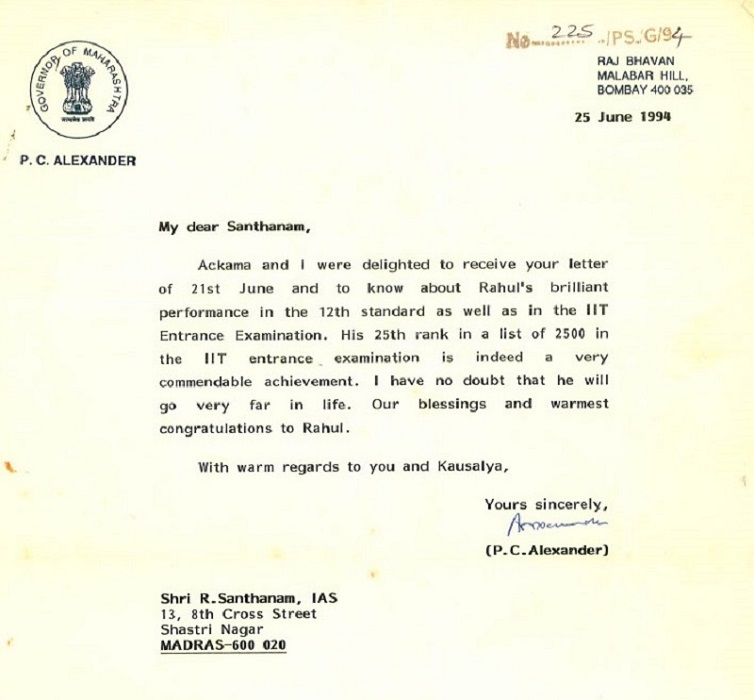
Both Alexander and his wife were always appreciative of the articles written by Kausalya in The Hindu. When Rahul did us proud by securing the 25th rank in the IIT entrance exam, I informed Alexander because he used to enquire about him. He wrote a nice letter which I’m sharing with the readers (Attachment-1)
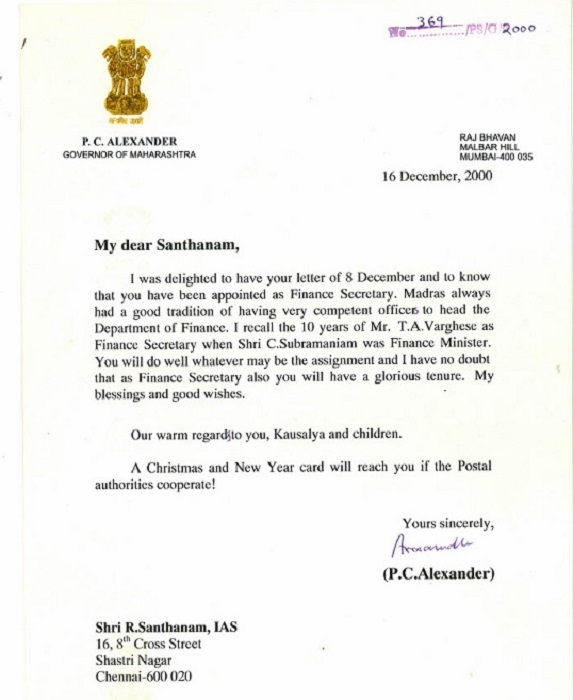
Alexander wrote another nice letter when I was posted as Finance Secretary in 2000. (Attachment-2)
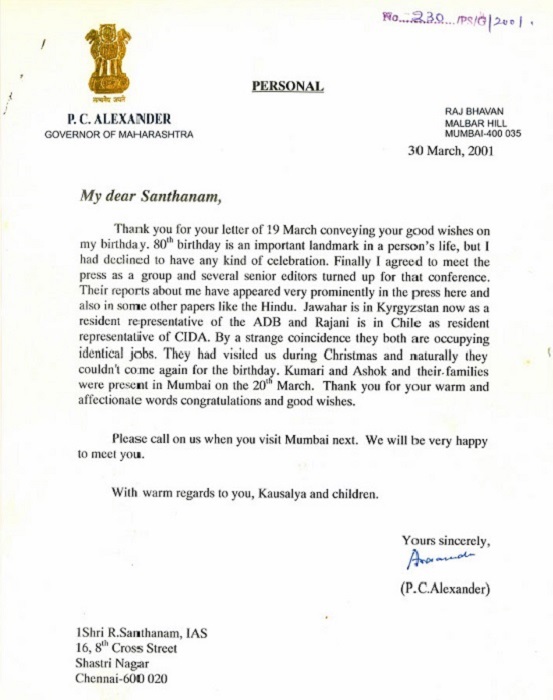
When I wished him on his 80th birthday, he wrote another letter which showed his warmth and affection. (Attachment-3)
| |
|
The above are the attachments referred to in the article.Click on each image above to view the larger image
|
|
Alexander had a very successful tenure in Maharashtra. He got along well with both Bal Thackeray and Sharad Pawar. In 2002, the BJP government led by Atal Bihari Vajpayee wanted to put him up as their candidate for President. But the BJP didn’t have enough votes of its own to ensure victory. It approached the Congress party but ironically the Congress did not agree although Alexander had served as Principal Secretary to both Indira Gandhi and Rajiv Gandhi and was perceived to be close to the Gandhi family. Alexander himself told me when I called on him later that it was because Sonia Gandhi wanted to become Prime Minister in 2004 and if Alexander was made President she could not have become PM because the people would not accept both the President and PM from the same minority community.
The last time we met him was at his residence in Kotturpuram in 2008. He was not keeping good health but was as alert and sharp as ever.
I was in Hyderabad in August 2010 when I learnt that he had passed away. I consider it a privilege to have known him and worked with him because I learnt a lot from him. I will always remember him not only for his integrity, efficiency and impartiality but also for his fatherly affection for me. He was undoubtedly the best boss I have had in my career.
R. Santhanam
February 2022
)
)
)